Author: María del Mar Grandío, University of Murcia
New research from AlertHub explores how journalists cope with pressure, misinformation, emotional challenges and wellbeing while covering extreme weather events in Spain.
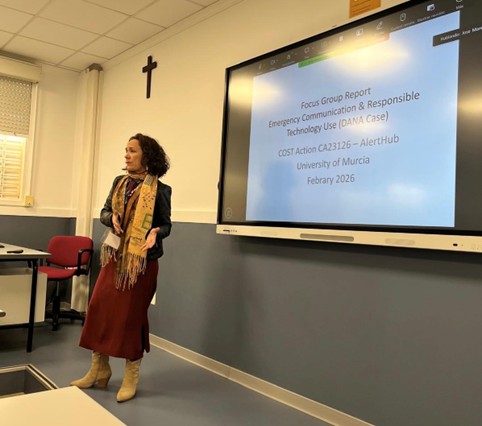
What happens behind the scenes when a natural disaster strikes? How do journalists report events unfolding in real time? These questions were explored by María del Mar Grandío (University of Murcia) during the Working Group 4 Meeting at the 4th Main Assembly of COST Action CA23126 – AlertHub, held in Murcia last February. Based on interviews with journalists from Antena 3 and regional public media in Murcia, including La 7 Región de Murcia and Onda Regional de Murcia, the research examines media coverage of environmental disasters, particularly DANA events affecting the Spanish Mediterranean. The study was supported by a Virtual Mobility Grant from COST Action CA23126 – AlertHub.
Main findings
One thing is clear: everything happens very fast. Journalists must quickly find out what is going on, locate the most affected areas and gather images and testimonies. At the same time, they need to make sure the information is accurate. Balancing speed and truth is one of their biggest challenges.
Even without strict rules, newsrooms know what to do. Teams switch to live coverage, work across different platforms and stay in close contact with authorities. Their role goes beyond reporting. They also provide essential information to the public, such as road closures, weather warnings or school disruptions.
Another major issue is misinformation. During a crisis, false information can spread just as quickly as the event itself. Journalists highlighted the importance of checking official sources and, when possible, verifying information on the ground. In this sense, they act as a first line of defence against rumours and hoaxes
Reporting disasters is also emotional. Human stories help people understand what is happening. However, journalists agree on one key point: emotion should never replace accuracy. Facts must always come first. Technology adds new layers to this challenge. Social media can be useful, but they also spread misinformation. At the same time, artificial intelligence makes it easier to create very realistic fake images. This makes verification even more difficult.
So, what can be done to improve the way emergency alerts are communicated?
The discussion with the member of the Cost Action Group in Murcia points to several important steps forward. First, there is a clear need for stronger professional standards in crisis reporting. Journalists are already working under pressure, but clearer guidelines—especially for fast-moving situations—could help them balance speed and accuracy more effectively
Second, better protocols are needed for the use of social media and artificial intelligence. Newsrooms must adapt to a landscape where false information and manipulated images can spread in seconds. This means investing in verification tools, training, and shared practices across media organisations.
Another key area is collaboration. Stronger links between journalists, public authorities and emergency services could improve the flow of reliable information during crises. This would help ensure that citizens receive clear, consistent and trustworthy updates. Finally, media literacy and digital wellbeing plays a crucial role. Citizens are not just passive receivers of information. They also share, interpret and react to what they see. Helping people understand how to identify reliable sources and question misleading content is essential.
Improving emergency communication is a shared responsibility. It involves journalists, institutions and the public. Members of the REMEDIS Task Force are also working to expand this line of research to other European geographical contexts, with the aim of providing broader comparative perspectives and contributions from a wider international framework
Contact:
María del Mar Grandío | University of Murcia |email: mgrandio@um.es