Author: Aleksanar Ivanov | Faculty for Security| Skopje
Earlier this year, AlertHub, in its second year as a network, brought one of its meetings to Murcia, Spain — and it turned out to be an experience that went far beyond the agenda.
A Monastery That Looks Like the Past, but Lives the Future from Within
The meeting took place at the Catholic University of Murcia, in February 2026. The first impression is fascinating: the campus is literally a medieval monastery. The massive stone walls and broad arches carry the weight of tradition, and despite the courtyards full of students, one could easily think that time had simply stopped there in the past.
Yet at the end of the second day, when they presented their work on risk and emergency management, the picture changed completely. We visited the basements of that historic complex — and it was precisely there that the future was waiting for us.
Classrooms fully equipped for virtual reality (VR), as well as for creating, testing and competing in video games. Robotic systems. Advanced programming. Sophisticated simulations. This is equipment that is used daily in real teaching routines and practical work.
The moment that stayed with me the longest and made me think most deeply was the training for response in urgent and emergency situations. It was not only about “what the digital scenario looks like”, but about how the human being reacts to it physiologically and psychologically. The simulations were accompanied by precise measurements of neuro-biological indicators among participants: stress levels, eye-gaze focus, pulse at moments of crisis, and so on.
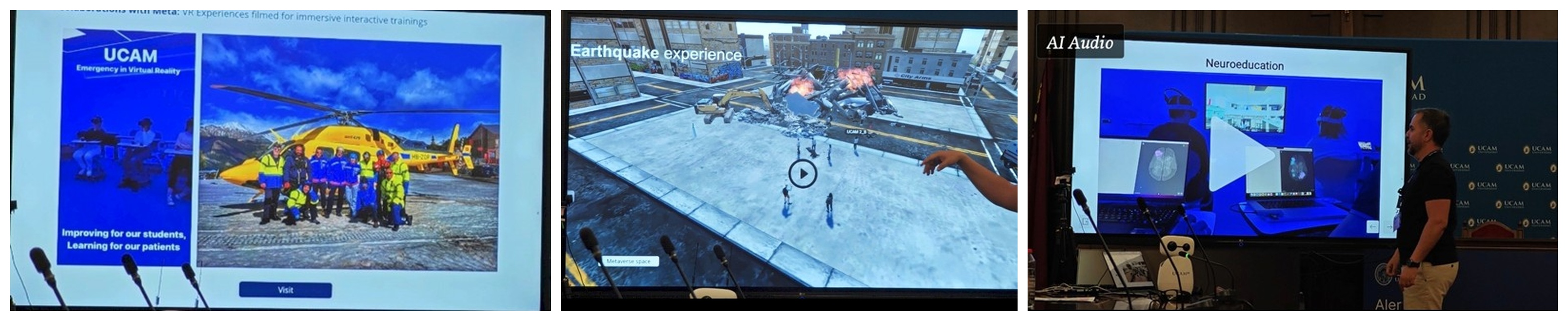
In one place, I saw a fully integrated ecosystem: a video library of simulations, practical exercises, strict systematic protocols, and above all a solid research framework that turns training data — extracted while trainees are actively undergoing those very exercises — into science; and that science, into relevant publications.
Why It Felt Familiar — and Where We Actually Get Stuck
The scene was not entirely unfamiliar. Through my home university, “St. Kliment Ohridski” University, and the Faculty of Security – Skopje, I had previously been part of a multi-year project within NATO’s Science for Peace and Security Programme (2020–2022). We had the rare and valuable opportunity to see what it means to use technologies such as photogrammetry and virtual reconstruction of a scene. We saw what training looks like when a crime or crisis scene is not a sketch drawn on a board, but a three-dimensional environment in which one moves, analyses and makes decisions.
But precisely that experience, when compared with the reality in Murcia, opened a simple yet extremely difficult question for me: How can I, as a researcher from North Macedonia — especially in the field of the social sciences — gain continuous access to the same technologies in order to conduct systematic comparative research?
More broadly still, how could we generate and compare the neuro-biological responses to crisis among participants in trainings from Macedonia and Spain, or from different countries across the globe?
The short answer is uncomfortable: realistically — with great difficulty. And this is not because we lack intelligent people, talented students or dedicated staff. The problem is that we suffer from the “pilot-project syndrome”. We lack sustainable conditions that would allow us to turn knowledge into continuous results. Once the foreign donor leaves, equipment often remains unused due to a lack of budget for maintenance or licenses. This brings us to the bitter essence of the issue: progressive ideas are not born only in the minds of exceptional individuals; they can survive and grow only within a system that knows how to support them institutionally.
Five reasons that may explain why things “do not work” — although undoubtedly there is potential
-
Lack of vision and strategic goal-setting: I am not referring to vague political ambitions such as “entering the top 100 on the Shanghai Academic Ranking”. I am talking about a basic, logical and common-sense decision: which three or four key capacities do we want to build over the next five years, and what will be our recognizable (national) contribution to European science? Without such a goal, buying expensive equipment will do little for building a system.
-
Absence of a national inventory of technologies and infrastructure: today, I am not sure that we know at the national level exactly what we possess. I am reminded of medical devices purchased for the healthcare system that were later forgotten, locked away in a room no one enters. Which laboratories exist, what devices are gathering dust at faculties, what licenses do we have, and what are the possibilities for their joint use?
-
Obstruction instead of clustering: too often, faculties and institutes work in parallel — sometimes even competitively — on the same issues where they should be complementary. A small and financially fragile system needs strategic coordination.
-
Wrong incentives in higher education: when the state and educational system reward aggressive marketing and the hyperproduction of papers in questionable journals more than genuine quality, we end up with “education as business” instead of education as public values; the problem arises when the rules for academic advancement do not reward painstaking research and development, but only the chasing of numbers.
-
Fragmented resources in areas of scarcity: some research capacities are simply too expensive for every institution to have separately.
The essence is that progressiveness is not fashion — it is organization
What I witnessed in Murcia is deeply symbolic. The old walls of the monastery do not hinder new technological ideas. On the contrary, tradition there is not a brake, but a foundation for academic discipline, while technology is merely a powerful tool in the hands of that discipline. Modern teaching does not mean “buying VR headsets so that we look modern on social media”. Modern teaching means developing a methodology that connects training with research, and research with real public benefit.
And here, the social sciences may have the most important role, although they are often unfairly marginalized in the era of IT expansion. A piece of software can perfectly simulate a fire, a devastating flood, an earthquake or mass unrest. But only the social sciences can provide the crucial context: How does a crowd react in panic? How do leaders make decisions when the system collapses? How do fear, lack of trust in institutions and false information alter collective behaviour? In all emergencies, the “human factor” is not merely a secondary parameter or an ordinary addition; it is the very centre of the crisis. Technology sets the stage, but the human being defines the consequence.
When I return from meetings like this, while organizing my thoughts and impressions, I always ask myself the same question: what exactly is their “secret”? The answer is usually stripped of all romance. The secret lies in the fact that someone, at some point, made a strategic decision to connect three things: education, infrastructure and research — and to secure continuous funding for their sustainability
Author: Aleksanar Ivanov, Faculty for Security, Skopje, Republic of North Macedonia | contact: aleksandar.ivanov@uklo.edu.mk